Ever feel like you need an extra pair of hands, or maybe a whole extra brain, when you’re building software? It’s a big job, right? From coming up with the first idea to squashing those pesky bugs and getting everything deployed, there’s just so much to do.
For a while now, we’ve had AI helping us out. Think of tools that write code snippets or help you debug. But what if you could have a whole team of AIs, each with its own specialty, all working together on your project? That’s exactly what multi-agent AI systems are all about, and they’re starting to change how we think about software development.
Understanding AI Multi-Agent Systems in Software Development
So, what exactly is a ‘multi-agent system’? Think of it like this: instead of one super-smart AI trying to do everything, you have a bunch of AIs, each really good at one specific thing. One might be a whiz at security, another a pro at writing documentation, and yet another a master debugger.
The magic happens when these specialized AIs work together. It’s not just a collection of tools; it’s an orchestrated team. They communicate, hand off tasks, and even review each other’s work, much like a human development team would. The goal? To tackle complex software projects more efficiently and with higher quality than a single AI (or even a single human!) could manage alone.
The Architecture of Collaboration: How Agents Work Together
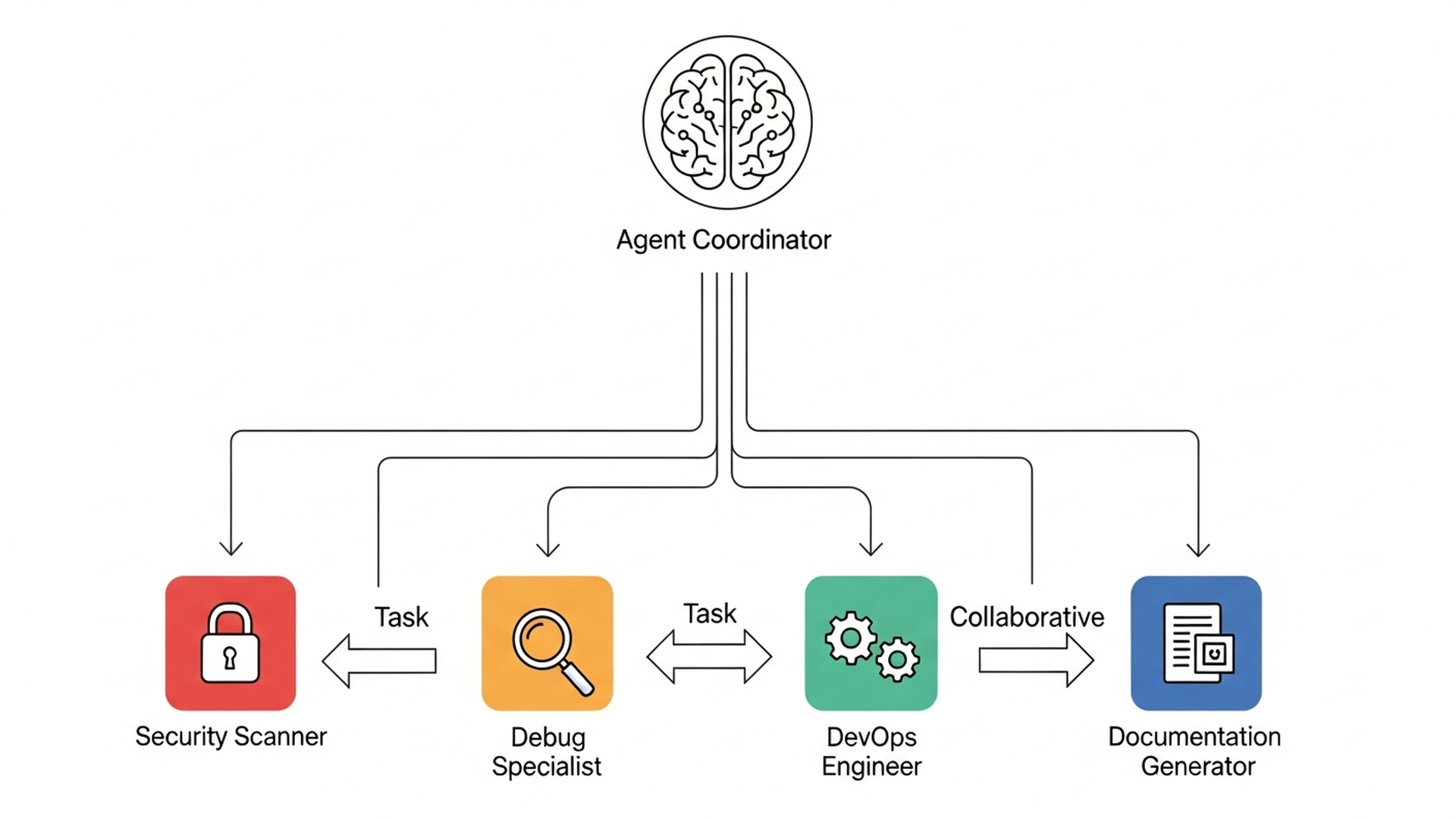
How do they know who does what? That’s where the ‘Agent Coordinator’ comes in. Imagine this coordinator as the project manager of your AI team. When you give the system a task – say, ‘build me a login system’ – the coordinator first breaks it down. It figures out:
- What kind of expertise is needed? (Security for login, obviously!)
- What’s the best order for tasks?
- Are there any quality checks needed along the way?
Once it has a plan, it delegates. It might send the initial design to a ‘Project Architect’ agent, then the coding part to a general ‘Coder’ agent (though not explicitly listed in the Reddit post, it’s implied), then the security aspects to a ‘Security Scanner,’ and finally, the ‘Code Reviewer’ checks everything over.
The Reddit post that inspired this chat, about ‘Claude Sub-Agents,’ gives us a fantastic peek into this. It lists agents like:
- Security Scanner: Hunts for vulnerabilities.
- Code Reviewer: Checks code quality.
- Debug Specialist: Finds and fixes errors.
- DevOps Engineer: Handles deployment and infrastructure.
- Documentation Generator: Writes all the necessary guides and comments.
- Feature Brainstormer: Helps with new ideas.
…and many more, each with a specific job.
It’s like having a full-stack team at your fingertips, but they’re all lines of code.
Transforming the SDLC: Key Applications and Benefits
So, how does this actually change how we build software? Well, it touches pretty much every part of the Software Development Life Cycle (SDLC).
- Idea & Planning: Got a vague idea? A ‘Feature Brainstormer’ can help flesh it out. Then a ‘Project Planner’ can break it down into manageable tasks, and a ‘Project Architect’ can lay out the big-picture design.
- Coding & Development: An ‘API Designer’ can map out your endpoints, and a ‘Data Analyst’ can help optimize your database queries.
- Testing & Quality: This is huge. The ‘Security Scanner’ can proactively find weaknesses. The ‘Code Reviewer’ ensures your code is clean and efficient. And when things go wrong, the ‘Debug Specialist’ jumps in to find the root cause.
- Deployment & Maintenance: A ‘DevOps Engineer’ agent can automate your deployment pipelines, getting your software out the door faster and more reliably. And the ‘Documentation Generator’ makes sure everyone knows how to use and maintain what’s been built.
The big wins here are pretty clear: things get done faster, with fewer mistakes, and often at a higher quality because you’re leveraging specialized expertise for every single step. It’s like having an expert on call for every tiny detail.
Case Study: The “Claude Sub-Agents” Project and Beyond
The ‘Claude Sub-Agents’ project, which you can find on GitHub (check out the repo if you’re curious!), is a fantastic real-world example of this in action. The creator mentioned they’re ‘not optimized but they are working,’ which is exactly the kind of honest, early-stage insight we love to see. It shows that even in its early forms, this multi-agent approach is already delivering value.
This project specifically uses Claude, a powerful AI model, to power its specialized agents. It’s a testament to how you can take a general-purpose AI and, by giving it specific roles and a smart coordinator, turn it into a highly effective, specialized team.
Beyond this specific project, imagine the possibilities: AI teams building custom plugins for WordPress, creating personalized learning modules, or even designing complex scientific simulations. The idea of an AI team that can handle a project from start to finish, adapting to new requirements, is incredibly exciting.
Challenges, Future Outlook, and Ethical Considerations
Now, it’s not all sunshine and rainbows. Building and managing these multi-agent systems isn’t simple. They can be complex to set up, integrate with existing tools, and ensure they’re always working as expected. You still need human oversight, especially for critical decisions and to ensure the AI isn’t introducing new biases or vulnerabilities.
But looking ahead, the future is pretty wild. We’ll likely see these systems become even more sophisticated, capable of handling even more complex tasks autonomously. This doesn’t mean humans are out of a job; far from it. Instead, our roles might shift. We’ll become the architects of these AI teams, the strategists, the quality controllers, and the innovators who push the boundaries of what’s possible.
Of course, with great power comes great responsibility. As AI takes on more autonomous roles in creating software, we need to think about things like accountability: who’s responsible if an AI-generated system has a critical flaw? And how do we ensure these systems are built and used ethically, without perpetuating biases or creating unintended consequences? These are big questions we’ll all need to grapple with as this technology evolves.
It’s an exciting time to be involved in software, and these multi-agent systems are definitely a trend to watch. They might just be the next big leap in how we build the digital world.
 Digify
Leave a comment